

Track Exposure.
Protect Your Team.
Built by Firefighters, for Firefighters
Designed with real-world operational insights to address critical gaps in exposure tracking. Created by a 26-year fire service veteran.
Real-Time Exposure & Incident Logging
Effortlessly document toxic exposure time and incident scenes.
Firefighter PPE Care
Track each piece of protective gear by serial number, with NFPA 1851 wash records, condition, and repair status.
City and personnel statistics
Career exposure for every firefighter, and department-wide totals built from the same incident timestamps.
Offline Incident Continuity
Keep recording on scene if the connection drops.
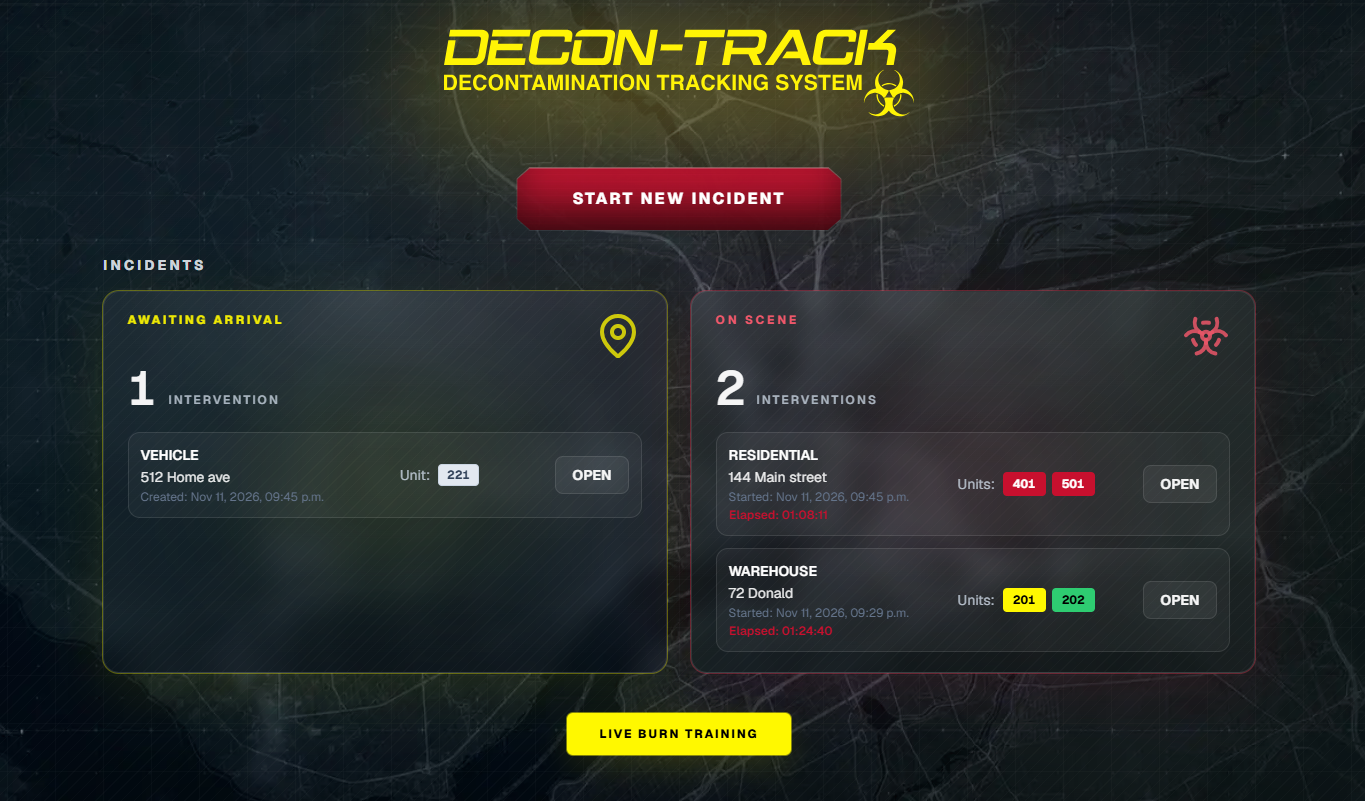
Driving the Future of Firefighter Safety
DECON-TRACK revolutionizes exposure tracking for modern fire services. By converting on-scene data into actionable intelligence, our platform empowers chiefs and city administrators to enforce NFPA compliance, mitigate long-term health risks, and safeguard their crews.
Read the full storyWhy is DECON-TRACK needed?
The Problem: Invisible Exposure & Manual Data Gaps
Firefighters face unavoidable occupational hazards, but exposure risks can be mitigated through intelligent, real-time data tracking.
Up to 25
Occupational cancer types and severe respiratory illnesses linked to firefighting in North America and Europe.
Still on paper
Departments still log exposure from memory, paper forms, and fragmented municipal records.
The cost of gaps
When exposure and decontamination records are incomplete, departments have less information to protect firefighters' health, support compensation processes, and advance occupational-health research.
Engineered for frontline fire operations.
Seamlessly integrated into every stage of the incident lifecycle.
Open, dispatch prep, on-scene decon dashboard, and close, from first alert to concluded record.
Per-seat exposure with server-backed durations and career totals on each firefighter profile.
Row and unit primary decon, shower timer, NOT EXPOSED clearance, and unit complete.
Filter, view, and export concluded incident data. CSV and Excel supported.
Simulator incidents with RECRUE workflow, isolated from operational unit locks.
On-scene guidance when high-toxicity materials are present, with specialized decontamination steps tied to the incident.
NFPA 1851 gear maintenance for every serial number
Track jackets, pants, gloves, helmets, boots, and hoods as assigned gear, with a wash and condition record on each piece.
- Serial number tracking
Each jacket, pants, gloves, helmet, boots, and hood keeps its own maintenance and wash log.
- NFPA 1851 wash records
Log routine and advanced cleanings and keep a complete trail for every piece.
- Condition and status
See which pieces are in service, need repair, or are out for maintenance before they return to duty.
- Inventory on the profile
Add a new piece directly to the firefighter's assigned gear so unit records stay current.
Cleaning and repair records help remove fireground contaminants from the ensemble and give the department an audit-ready history for each piece.
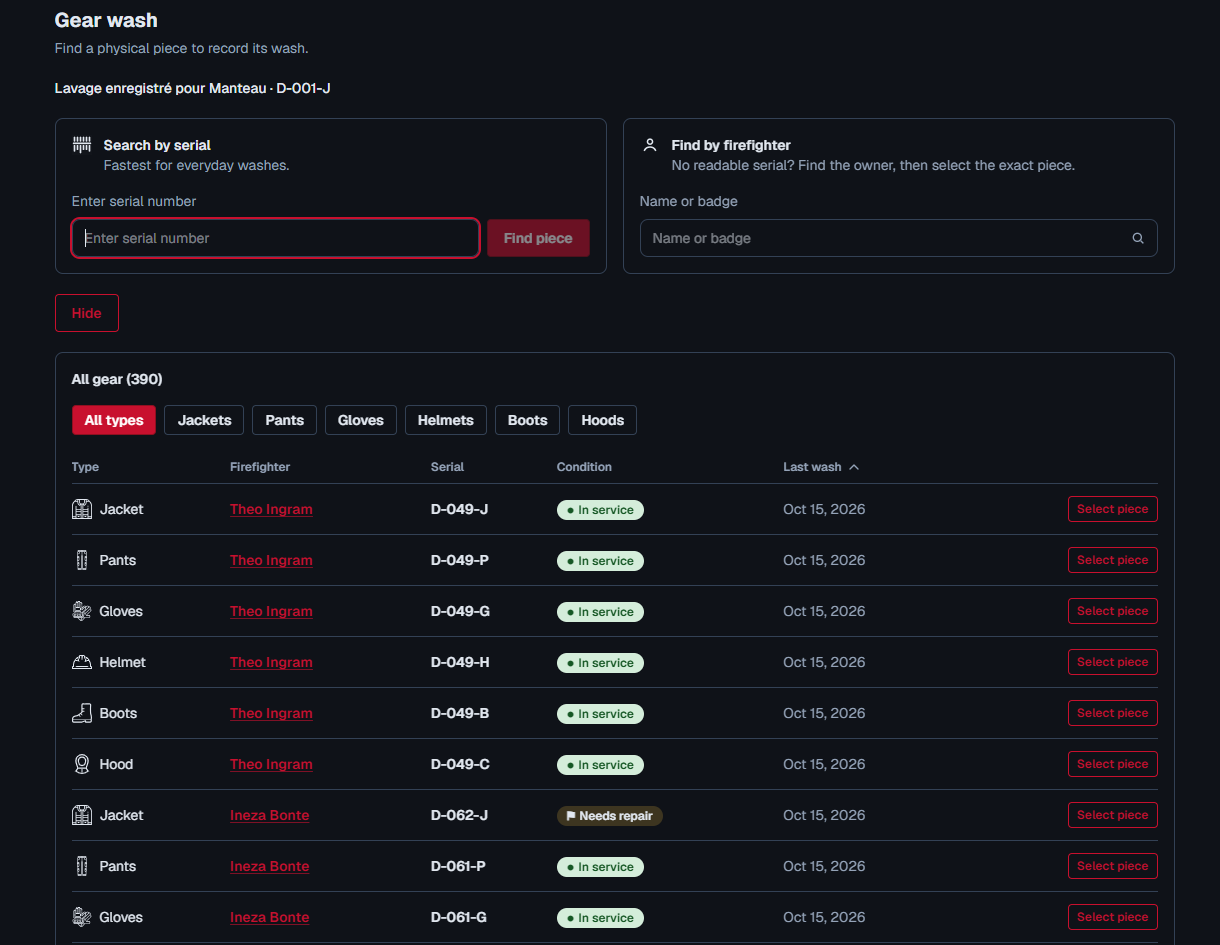
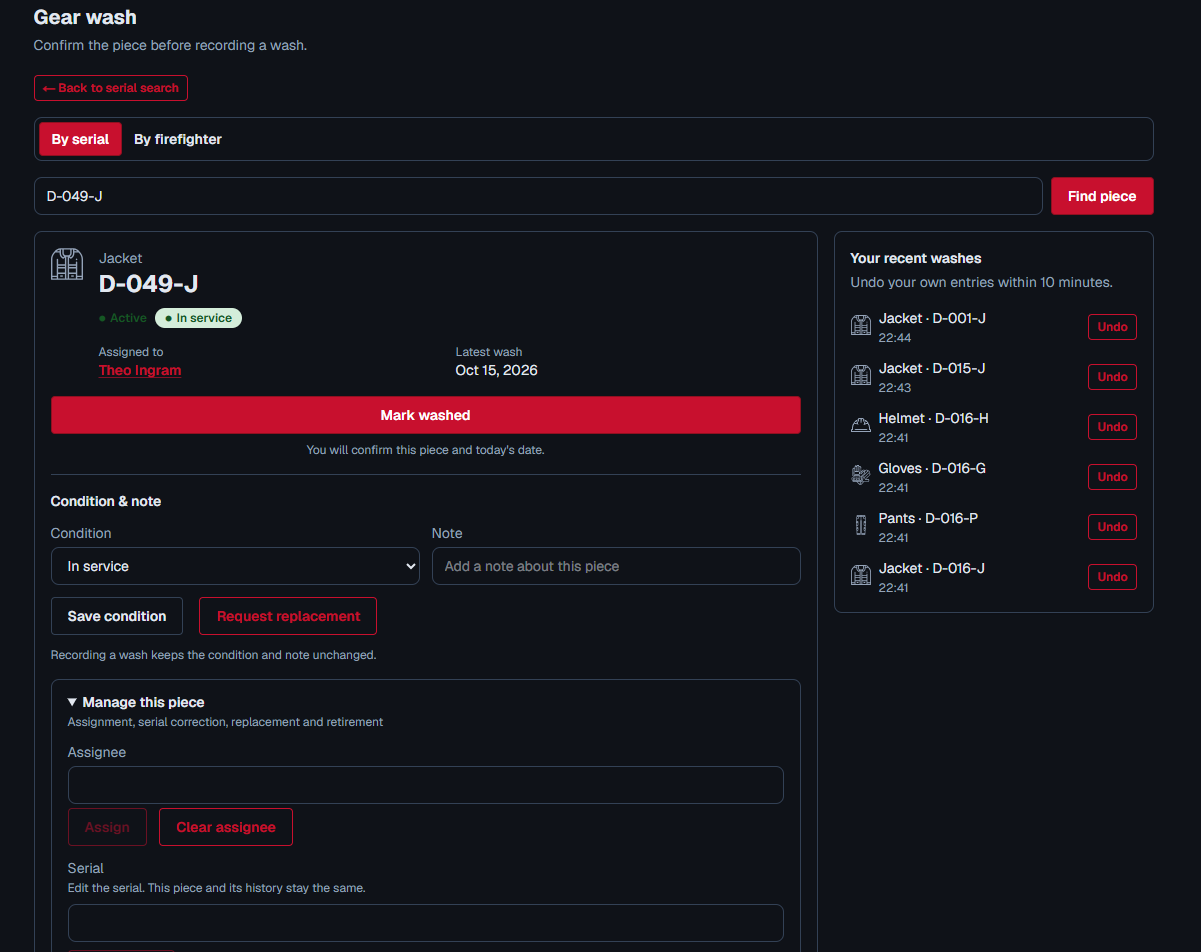
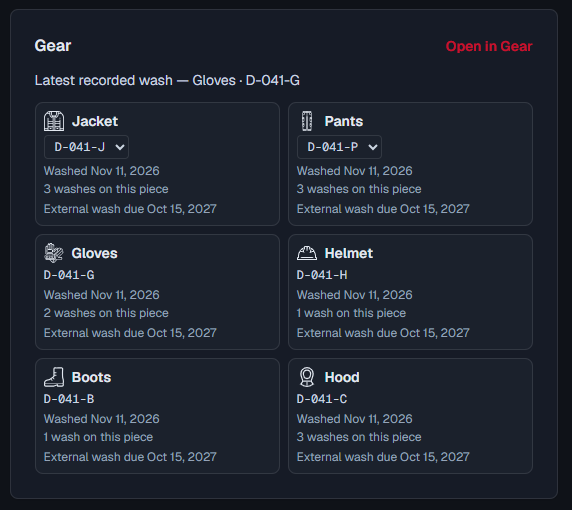
Gear inventory
Search by serial or firefighter. Filter jackets, pants, gloves, helmets, boots, and hoods.
Individual statistics for every firefighter
Career exposure and incident participation, built from the same timestamps used in operational reports, not reconstructed from paper.
- Career exposure
Cumulative on-scene exposure time on each personnel profile.
- Incident participation
Total incidents and breakdown by type, including operational and practice history.
- Shower compliance
NFPA timing buckets and average shower-to-clear time per seat session.
- PDF export
Downloadable profile summary for records and accountability.
Secure Personal Records
A planned personal-access flow gives firefighters secure, read-only access to their verified career exposure history and individual safety records.
On-Demand Access Request
A designated officer opens the firefighter's profile within the command portal to generate a secure QR code.
Instant Scan & Secure Login
The firefighter scans the QR code using their mobile phone to authenticate through a secure login.
Personal Health Statistics
Personnel gain immediate, read-only access to their verified career exposure history and individual safety records.
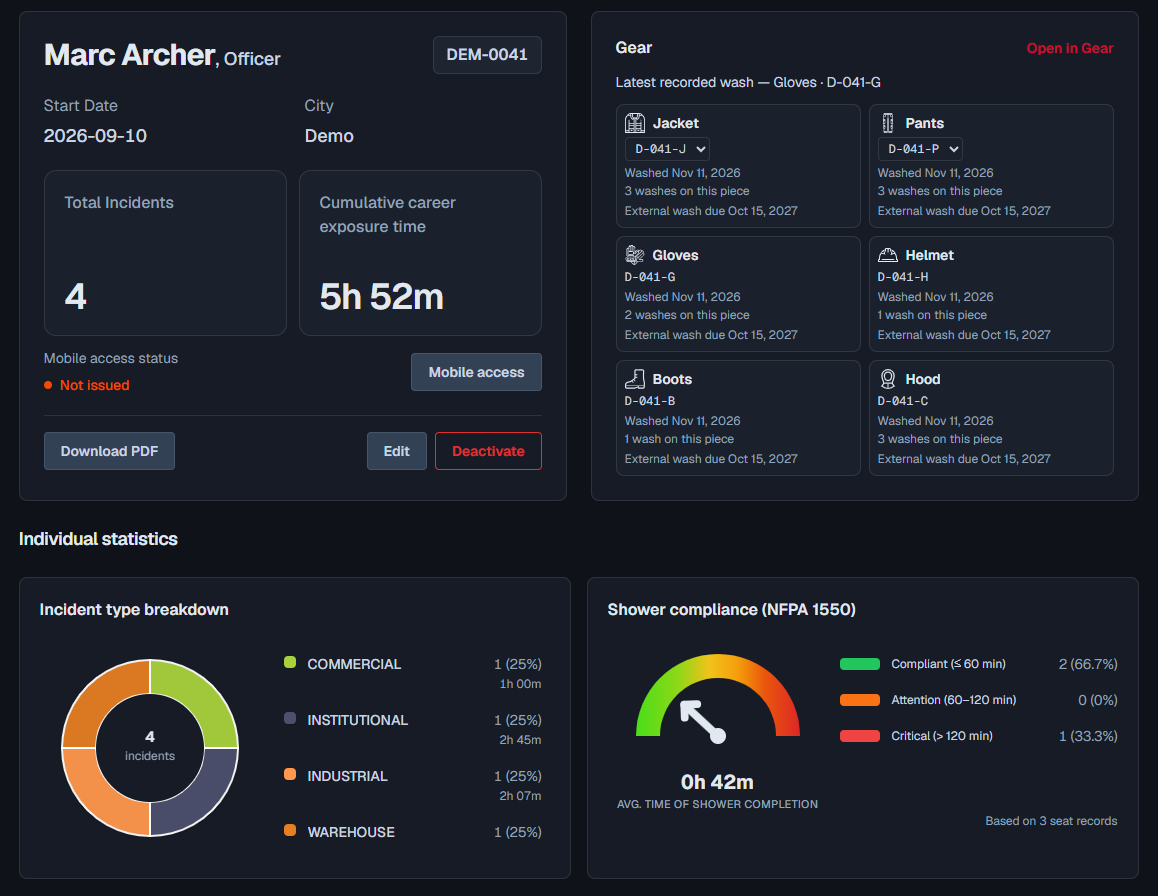
Personnel dashboard
Career exposure, incident history, and compliance—on one profile.
Personal mobile devices only: read-only personal statistics. Access is limited on the server. No roster, incidents, reports, or other profiles.
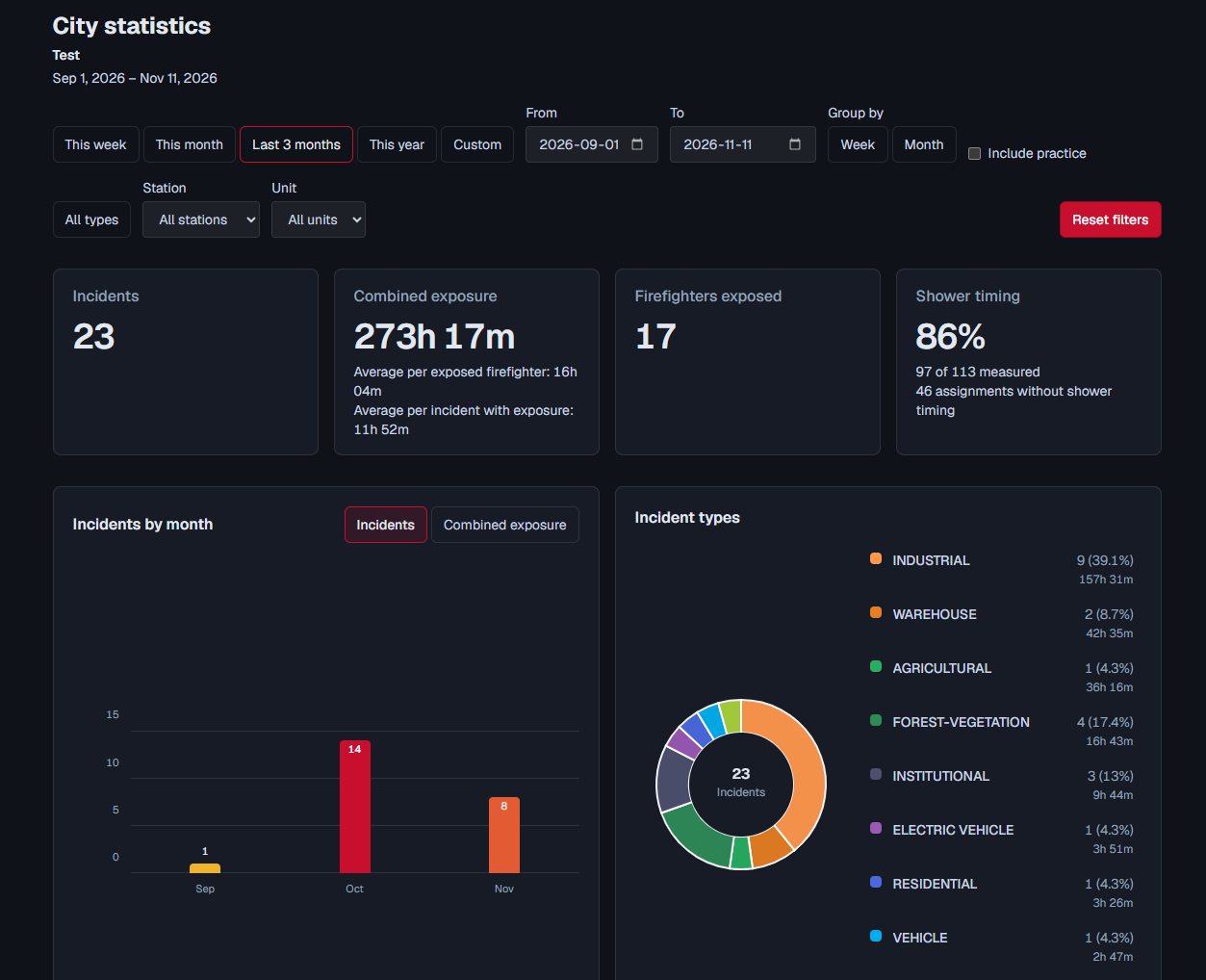
Department exposure, in one view
City-wide incidents, exposure time, and shower timing, built from the same timestamps as operational reports.
- Period totals
Incidents, combined exposure, and firefighters exposed for the week, month, year, or a custom range.
- Shower timing
How many measured assignments met the shower window, and how many have no shower time recorded.
- Breakdowns
Stations, units, incident types, substances, and personnel exposure for the same period.
- Filters
Narrow the view by date, station, unit, incident type, and whether practice is included.
Three steps. One operational record.
Create incident
Open a new incident from a tablet at scene or command post. Address, type, and unit assignments captured in seconds.
Track personnel & exposure
Assign members, log exposure, and monitor decontamination. When online, the dashboard syncs across devices. On a prepared device, supported notebook work is saved locally and uploaded when connectivity returns.
Generate reports
Close the incident when units are complete. End Incident can be saved offline; the official report is available from the server after synchronization is confirmed.
Designed around real incidents
A typical car fire response, captured the way it actually unfolds.

Incident created
21:42:08DRAFT opened · car fire · 142 Rue Notre-Dame · units attached
On scene
21:44:31First unit Play → ACTIVE · roster snapshot loaded for Unit 201
Exposure logged
22:11:02Crew in the hot zone are marked exposed · server-backed timer running
Gross & shower
22:47:55Unit Gross started · shower timer running · members cleared NOT EXPOSED
Incident closed
23:00:00All started units COMP · exposure segments finalized · 1 h 32 min on scene
Report & records
23:00:05Report available from Reports · career exposure updated on personnel profiles

Ready to improve exposure tracking?
See DECON-TRACK set up for a department like yours. We'll walk through real workflows, your reporting needs, and deployment options.
Request a DemoTalk to the team.
Tell us about your department and we'll set up a working session with an operations lead.
- Sales & Demo
- info@decon-track.com
- Support
- support@decon-track.com
- Headquarters
- Gatineau, QC · Canada